
Vivaldi’s Violin Concerto in A Minor: Beyond the Student Concerto
Recently, I finished recording all three movements of Vivaldi’s Violin Concerto in A Minor, Op. 3, No. 6. It demanded far more time than I expected—and reminded me how much musical and technical depth can hide inside a piece we think we already know.
I first learned this concerto when I was about eleven. Years later, when I had my violin studio in Racine, Wisconsin, I taught it to young students preparing for solo and ensemble. They played it beautifully, from memory, and did extremely well.
Revisiting it as a professional violinist brought a different set of questions. Beyond accurate notes and secure intonation, could I sustain the articulation, energy, phrasing, and expressive clarity the music deserves?
Vivaldi’s A Minor Concerto is a serious violin concerto. Familiarity with it as teaching repertoire can cause us to underestimate it.
How the “Student Concerto” Label Shapes Our Playing
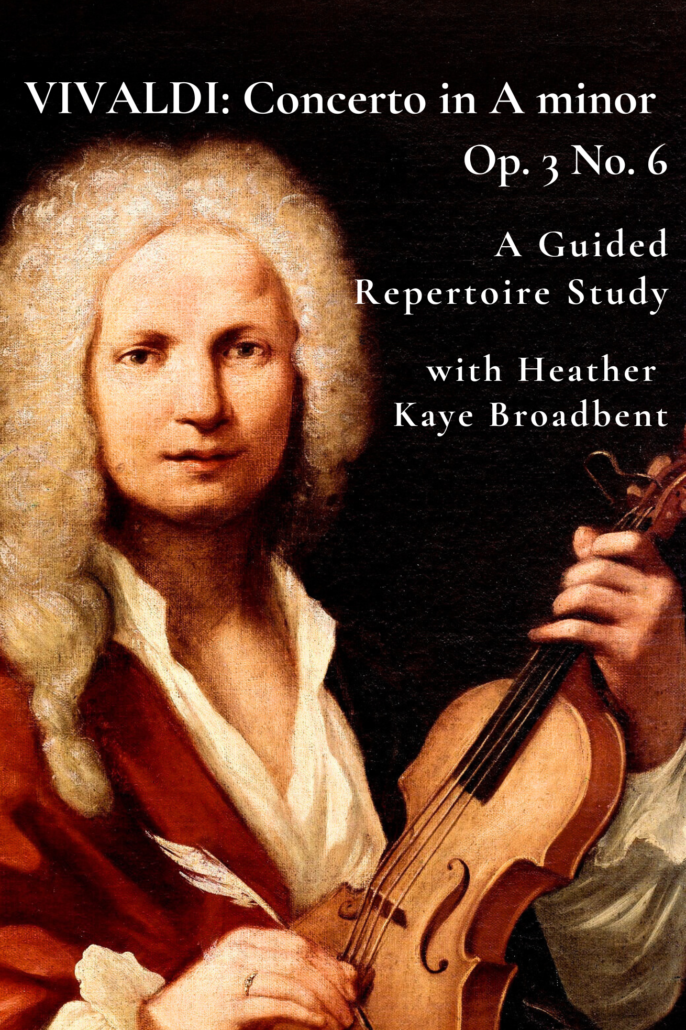
Many violinists encounter Vivaldi’s A Minor Concerto through the Suzuki books. That introduction can create a lasting impression: this is a piece we learn at a particular stage, complete, and move beyond.
But the stage at which we first encounter a work does not define its artistic possibilities.
When learning it as a young student, the immediate goal may be to play the notes accurately, get them in tune, add some phrasing, and arrive at the final note without a catastrophe. Those are meaningful accomplishments.
Returning to the same concerto with a more developed musical understanding reveals another level of work. The sixteenth notes need direction. The string crossings need clarity. The dynamics need character. The bow must support the phrase throughout.
The familiar notes become a much more demanding musical responsibility.
The Third Movement: What Presto Asks of Us
The third movement is marked Presto. Its speed and energy are central to its character, but a tempo word alone does not determine one compulsory metronome setting. The musical task is to find a pace that brings the movement to life while preserving clarity and expression.
When the movement is played at a comfortable, restrained tempo, it can seem relatively manageable. Bringing it closer to its full energetic character changes the experience considerably.
The sixteenth notes become more challenging. String crossings require quicker preparation. Shifts need to arrive promptly. The bow arm must respond efficiently, and the phrasing still has to speak.
Tempo reveals whether our technical organization can support our musical intention.
Slow practice gives us time to examine and develop that organization. Playing at performance tempo shows us how well it holds together.
Martelé: Preparation, Release, and Ring
One technical demand I discuss in the video is the martelé bow stroke on eighth notes.
The challenge lies in coordinating preparation with release. We prepare the articulation before moving the bow, then release so the sound can ring.
If we carry the initial pressure through the stroke, the result can sound pushed. A clear beginning needs freedom afterward.
That balance matters musically. The articulation should give the phrase definition and energy while allowing the violin’s sound to remain alive.
Phrasing the Sixteenth Notes
Fast notes can easily become a task of keeping up. Yet those passages have a musical structure: triads, broken arpeggios, sequences, and harmonic direction.
Understanding that structure changes how we practice and perform them.
Where is the pattern leading? Which notes belong together? Where does the phrase grow, and where does it release?
When those relationships become clear, the notes gain direction. We can shape the passage instead of simply moving through it.
Dynamic contrasts also need enough definition to register with the listener. Their purpose is to bring the music’s character and architecture into focus.
Bow Distribution and String Crossings
Bow distribution is essential in this concerto. You need to know where you are in the bow and how much bow each gesture requires.
Are you in the upper half or near the middle? Does the next passage need more bow available? How will you travel to the next string without adding unnecessary movement?
The third movement makes these questions especially immediate. Its rapid string crossings demand economical coordination. Extra movement costs time and energy, and that cost accumulates across a long passage.
Efficient bowing supports endurance, clear articulation, and expressive freedom.
Reading Fast Passages in Groups
At slower tempi, we have more time to attend to individual notes. Faster playing requires us to recognize larger units.
In the third movement’s 2/4 meter, that may mean seeing a beat—or, where the pattern allows, a whole measure—as a musical word.
A pattern containing separate notes and a two-note slur becomes easier to organize when we recognize the complete group. The bowing belongs to one coordinated gesture rather than a series of isolated instructions.
This affects both reading and movement. Seeing the group gives the bow arm a clearer plan.
In some passages, a flowing tempo can even help the bowing work more naturally, provided the coordination is already prepared.
What Does It Mean to Have Learned a Concerto?
Playing from the first note to the last is one milestone. A fuller measure of mastery is whether we can sustain intonation, articulation, clarity, and musical expression within the tempo and structure of the work.
Can the technique carry the phrase? Can we maintain the character through the demanding passages? Can we express ourselves within the concerto?
Those questions made my return to Vivaldi’s A Minor Concerto so rewarding. A work I had known since childhood still had more to teach me.
Study Repertoire with Heather
At Broadbent School of Violin Artistry, I train adult violinists to play expressively with technical ease.
The school is organized into Study Rooms so you can connect specific areas of development with the music you are learning. Vivaldi’s Violin Concerto in A Minor belongs in the Repertoire Room, where teaching videos and courses support progressive, expressive study.
If you are learning this concerto—or returning to it after many years—I invite you to approach it with fresh ears and a deeper musical intention.
Explore the Repertoire Room and develop the tools to bring the music to life, helping you return home to you as a violinist.
I’ll see you there.
Heather
Related Studies
If you are working on the Bach Violin Concerto in A Minor, you may also find these resources helpful:
• Bach Violin Concerto in A Minor – First Movement Allegro
• Bach Violin Concerto in A Minor – Second Movement Andante
• How to Practice Bach Violin Concerto in A Minor – Third Movement (m. 82-90)
💫 Explore the full guided course:
Bach Violin Concerto in A Minor Guided Repertoire Study
Happy Practicing,
Study Violin with Personal Guidance
If something in your violin playing still isn’t working the way you’d like, individualized guidance can often reveal the missing piece.
In private online lessons we focus on the specific elements that shape beautiful violin playing — tone production, bow coordination, intonation, and thoughtful practice strategy.
Each lesson is tailored to your playing so that the next steps in your development become clear and achievable.
For violinists seeking deeper progress and consistent guidance, lesson packages offer the most effective and economical way to study.
Heather Kaye Broadbent is a concert violinist and founder of the Broadbent School of Violin Artistry, where she helps violinists develop beautiful tone, refined technique, and deeper musical understanding through guided study, online courses, and private instruction.

I’d Love to Hear From You
Have you studied this piece or worked through similar technical challenges?
Feel free to share your experience or questions below.


Leave a Reply
Want to join the discussion?Feel free to contribute!