
From C Major Studies to Music: Applying Violin Technique in Practice
Practice with Heather | Broadbent School of Violin Artistry
Welcome to Practice with Heather! Today I’m inviting you into my practice room to share how I apply C major technical studies to a piece of music.
Before recording this session, I had spent approximately ninety minutes practicing C major studies in first position. I decided to continue that work using Preludium, No. 1 from Kötscher’s Bach Studies.
It’s a lovely little piece, only four lines long, entirely in first position, and written in the style of Bach. I originally discovered these studies while looking for preparatory material for students approaching Bach’s Solo Sonatas and Partitas.
For today’s practice, however, my interest isn’t so much in learning the Preludium itself. It’s in taking the technical work I’ve already done and applying it to music.
Watch Practice with Heather: C Major in Application
Join me in the practice room as I work through Kötscher’s Preludium, exploring intonation, left-hand organization, and the application of C major studies.
Bring Your Practice into The Practice Room 🎻
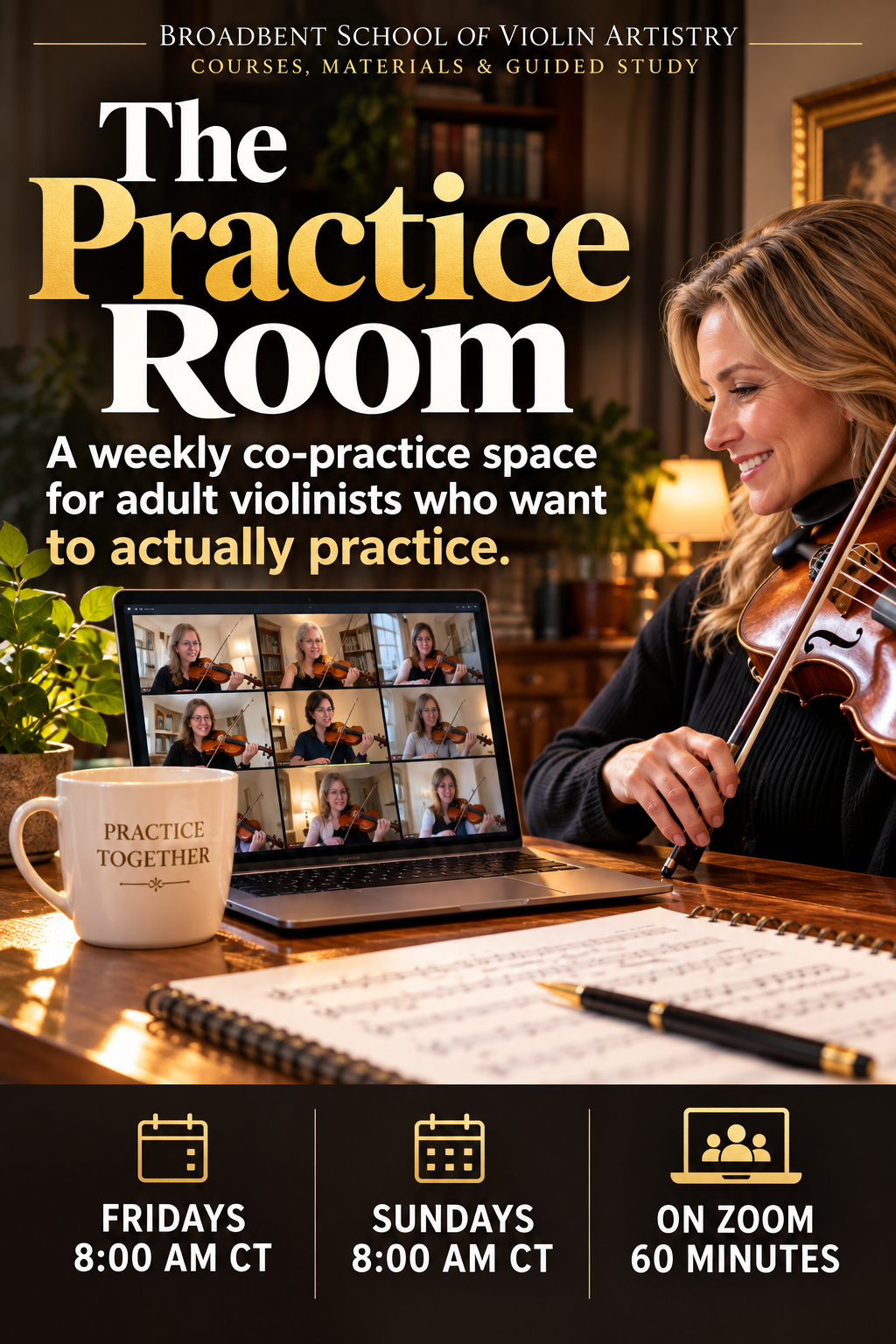
Thoughtful, focused practice is at the heart of developing as a violinist. But finding the time—and consistently making that time a priority—can be challenging.
That’s why I created The Practice Room, a live, online co-practice space for adult violinists at the Broadbent School of Violin Artistry.
Twice each week, we meet on Zoom, take out our violins, and dedicate an hour to practicing together.
You bring whatever you’re working on—scales, études, repertoire, or a passage that needs extra attention. There is no assigned music, no performance pressure, and no requirement to play for anyone.
We simply share the time, focus, and quiet accountability of practicing alongside other violinists.
Fridays & Sundays | 8:00 AM Central | 60 minutes
All levels are welcome. You don’t need to be a current student of the Broadbent School to participate.
Your practice is your own. The time is ours to share.
Why Practice C Major?
C major is a wonderful key for developing an understanding of finger placement and the relationships between notes.
Working through scales, arpeggios, and different finger patterns gives us an opportunity to concentrate on the organization of the left hand without the additional demands of a complicated piece.
But technical exercises are only part of the process. Eventually, we need to take what we’ve practiced and use it in a musical setting.
That’s where a short study like this becomes so valuable.
Moving from Scales to Repertoire
One of the challenges in violin playing is transferring what we learn in technical studies into actual music.
We may play a scale beautifully, with accurate intonation and a well-organized left hand, only to discover that those same finger relationships become less reliable when the notes appear in a different musical pattern.
In this session, I’m using Kötscher’s Preludium to explore exactly that.
Rather than playing through the entire piece, I stop frequently to examine individual movements and listen to the relationships between notes.
Intonation as the Primary Focus
Throughout this practice session, my first priority is intonation.
Even when working with relatively simple material, I continually evaluate the accuracy of each note and its relationship to the surrounding musical structure.
The opening measure provides a good example.
I divide it into two smaller sections. The first establishes the C major arpeggio. The second introduces an extended fourth finger.
Rather than simply playing through the measure repeatedly, I isolate the physical movement and listen carefully to the resulting pitches.
One particular concern is ensuring that the hand returns to its normal organization after the fourth-finger extension.
When returning to A natural, I want to hear that the note is accurately placed rather than allowing the extension to distort the hand’s subsequent positioning.
This is a small technical detail, but these details accumulate throughout a performance.
Secure intonation depends not only on placing a finger correctly, but also on understanding how the hand moves between different finger patterns.
Working on Intonation
Intonation is my primary focus throughout this practice session.
I’m listening carefully to the placement of individual fingers, particularly when the hand moves between different patterns.
For example, the opening measure introduces a C major arpeggio followed by an extended fourth finger.
The challenge isn’t simply reaching the extended note. It’s also returning to the original hand position and making sure the following A natural is accurately placed.
These are the details I enjoy exploring in my practice.
Understanding the Harmonic Architecture
One of the most valuable aspects of this study is the opportunity to recognize the harmony beneath the written notes.
In the opening phrase, I identify a progression moving through C major seventh, F major, G dominant seventh, and back to C major.
Rather than treating the passage as a succession of individual notes, I explore its harmonic structure through double stops.
This helps reveal the architecture of the phrase.
For a violinist preparing to study Bach, this kind of harmonic awareness is particularly important.
Bach’s solo violin writing frequently implies several musical voices through arpeggiation, double stops, and melodic movement.
Understanding the harmonic foundation allows us to hear more than the immediate melodic line.
It also influences how we organize intonation and eventually how we shape a musical phrase.
Harmony is not separate from technique. It informs the way we hear, organize, and play the instrument.
The Extended Fourth Finger
Fourth-finger extensions are an excellent opportunity to examine how the entire left hand is organized.
I’m paying attention to the position of my elbow, the relationship between the fingers, and how the hand accommodates the extension.
It’s easy to concentrate so much on reaching a note that we overlook what happens afterward.
I want the extension to be comfortable, but I also want the hand to return naturally to its original organization.
Using Finger Relationships to Establish Intonation
As I continue through the study, I encounter passages that require particular attention to finger placement.
In one measure, I remind myself to keep the first finger down. I had already written this instruction into my music, yet during practice I still needed to stop and reinforce it.
This is a normal part of technical development.
Recognizing a technical requirement intellectually does not necessarily mean that the physical movement has become established.
In another passage, I find that locating the third finger first helps me establish a more reliable F-sharp.
Instead of approaching each note independently, I use the relationship between fingers to organize the hand.
This approach becomes especially valuable when working with changing finger patterns and unfamiliar harmonic relationships.
Exploring Harmony Through Double Stops
Another interesting aspect of this little study is its harmonic structure.
In the opening phrase, I explore the progression through C major seventh, F major, G dominant seventh, and back to C major.
By playing double stops, I can hear the relationships between the notes more clearly.
This is particularly useful when preparing for Bach’s solo violin music, where the harmonic structure is often suggested through a single melodic line.
Understanding the harmony helps us hear where the music is going rather than simply playing one note after another.
Using Finger Relationships to Improve Intonation
As I work through the study, I find several places where the relationship between fingers helps establish accurate intonation.
In one passage, I remind myself to keep my first finger down. I had even written the reminder into my music!
In another, placing the third finger first helps me locate F-sharp more accurately.
These are small adjustments, but they illustrate an important part of practicing: learning to organize the hand through familiar finger relationships rather than treating every note as an isolated movement.
Recognizing Our Own Technical Habits
Something else I mention during the session is that I played on a larger violin for approximately twenty years.
After changing instruments, I noticed that certain fingers occasionally wanted to land a little sharp.
Even after years of playing, our hands develop habits based on the instrument and the physical relationships we’ve become accustomed to.
For me, this means paying particular attention to certain notes, including the third-finger D when moving into D major.
It’s one of the reasons I continue working with fundamental studies. There’s always something to refine!
The Value of Short Musical Studies
I particularly enjoy using short pieces like this because they allow me to concentrate on one technical subject at a time.
There isn’t a great deal of music to learn, and the entire piece remains in first position.
That leaves plenty of room to explore intonation, finger preparation, extensions, and harmonic relationships.
A study doesn’t need to be difficult or lengthy to be useful.
Sometimes four lines of music are more than enough for a productive practice session.
Bringing Technical Work into Music
For me, the real value of technical studies comes when I begin applying them to repertoire.
The scales and exercises establish the foundation. A musical study gives me the opportunity to see how well that foundation is working.
And when I discover something that needs attention, I can return to the technical work with a clearer understanding of what I’m trying to accomplish.
That’s the relationship between technique and music that I wanted to share in this session of Practice with Heather.
Happy Practicing!
Heather Kaye Broadbent
Broadbent School of Violin Artistry
Happy Practicing,

Study Violin with Personal Guidance
If something in your violin playing still isn’t working the way you’d like, individualized guidance can often reveal the missing piece.
In private online lessons we focus on the specific elements that shape beautiful violin playing — tone production, bow coordination, intonation, and thoughtful practice strategy.
Each lesson is tailored to your playing so that the next steps in your development become clear and achievable.
For violinists seeking deeper progress and consistent guidance, lesson packages offer the most effective and economical way to study.
Heather Kaye Broadbent is a concert violinist and founder of the Broadbent School of Violin Artistry, where she helps violinists develop beautiful tone, refined technique, and deeper musical understanding through guided study, online courses, and private instruction.
I’d Love to Hear From You
Have you studied this piece or worked through similar technical challenges?
Feel free to share your experience or questions below.

Leave a Reply
Want to join the discussion?Feel free to contribute!