
How I Warm Up Before Practicing a Violin Concerto
Preparing Vivaldi’s Concerto in A Minor for Two Violins
How do you prepare your violin technique before beginning serious repertoire study?
When preparing a concerto for performance or recording, I like to begin by assessing where my technique is that particular day. Rather than immediately opening the concerto and playing through it, I use scales to identify what is working comfortably and what might need additional attention.
In this episode of Practice with Heather, I’m beginning preparations to record both violin parts of Vivaldi’s Concerto in A Minor for Two Violins, using the Nachez edition.
This edition presents some additional technical challenges compared with the version I have previously performed and taught. It provides an excellent opportunity to demonstrate how I approach unfamiliar material, even within a familiar composition.
Beginning with Scales
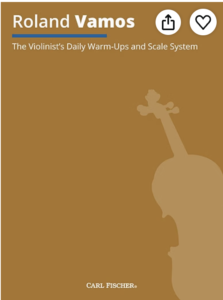
For this session, I begin with the A minor scales from the Vamos Violinist’s Daily Warm-Up and Scale System.
The two-octave scales offer several different starting finger patterns and opportunities to move through different positions.
Since the Vivaldi concerto requires facility across the first four positions, I want to establish a comfortable relationship with the fingerboard before moving into the music itself.
As I play, I’m listening for intonation, evaluating the coordination of my left hand, and observing how comfortably I move between positions.
What My Warm-Up Revealed
One of the interesting discoveries during this session was an uncomfortable shift from seventh position down to third position.
I noticed a tendency for my hand to collapse during the shift, which immediately identified an area requiring additional work.
This is one of the reasons I find structured warm-ups so valuable.
A warm-up is not simply preparation for practice. It can also reveal what needs to be practiced.
I also noticed that my second-position work felt particularly comfortable. Having recently completed a systematic progression of exercises in that position, I could recognize the benefits of that study.
These observations help determine where I direct my attention in future practice sessions.
The Value of Progressive Technical Study
Throughout my career, I’ve found that technical development becomes much more effective when exercises are organized into a logical progression.
A position is not truly mastered simply because we can locate the notes on the fingerboard.
We need to develop familiarity with finger patterns, intervals, shifting, intonation, and eventually more demanding applications such as double stops.
This is the approach I use in my own practice and in the teaching materials I develop for the Broadbent School of Violin Artistry.
Rather than treating every technical difficulty as an isolated problem, we can identify the underlying skill and develop it through carefully selected exercises, études, and repertoire.
The objective is to make technique increasingly reliable so that our attention can remain on the music.
From Technical Preparation to Musical Performance
Once I’ve completed my initial warm-up, the next stage is to examine the concerto in smaller sections.
I’ll identify passages that require particular attention, consider their technical demands, and begin organizing the work necessary to prepare them for recording.
This process is something I use whether I’m revisiting familiar repertoire or approaching a new composition.
And it is precisely the kind of independent technical thinking I want violinists to develop.
Continue Your Violin Study at the Broadbent School
If you’ve ever recognized a technical difficulty in your playing but weren’t certain which exercises would help you resolve it, the Broadbent School of Violin Artistry offers a more systematic approach to violin study.
The School brings together progressive technical studies, guided exercises, repertoire applications, and opportunities for Co-Practice.
Through the BSVA School Membership, adult violinists can explore the School’s course library and develop their technique according to their individual needs and musical interests.
Explore the Broadbent School of Violin Artistry
In the next Practice with Heather session, I’ll move beyond the warm-up and demonstrate how I break down the Vivaldi concerto into sections for focused practice and performance preparation.
Happy practicing!
Heather Kaye Broadbent
Violinist • Performer • Pedagogue
Founder, Broadbent School of Violin Artistry
Study Violin with Personal Guidance
If something in your violin playing still isn’t working the way you’d like, individualized guidance can often reveal the missing piece.
In private online lessons we focus on the specific elements that shape beautiful violin playing — tone production, bow coordination, intonation, and thoughtful practice strategy.
Each lesson is tailored to your playing so that the next steps in your development become clear and achievable.
For violinists seeking deeper progress and consistent guidance, lesson packages offer the most effective and economical way to study.
Heather Kaye Broadbent is a concert violinist and founder of the Broadbent School of Violin Artistry, where she helps violinists develop beautiful tone, refined technique, and deeper musical understanding through guided study, online courses, and private instruction.

I’d Love to Hear From You
Have you studied this piece or worked through similar technical challenges?
Feel free to share your experience or questions below.

Leave a Reply
Want to join the discussion?Feel free to contribute!