
How to Get Back Into Violin After Years Away: A Practice Guide for Returning Adult Violinists
Returning to the violin after months, years, or even decades? Whether you once played in an orchestra, studied classical repertoire, or simply enjoyed practicing regularly, coming back to the instrument can feel both exciting and challenging.
You may remember exactly how you want your violin to sound, yet find that your fingers, bow arm, intonation, and vibrato aren’t responding quite as they once did.
The good news is that you don’t need to begin with hours of daily practice. You need a thoughtful, consistent approach that allows you to rebuild your technique without overwhelming yourself.
I’m Heather Kaye Broadbent, a professional classical violinist and founder of the Broadbent School of Violin Artistry. I specialize in helping dedicated adult violinists develop refined technique, beautiful tone, and greater confidence in their playing.
In this guide, I’ll walk you through the technical areas I recommend revisiting when returning to the violin after a long break.
Watch the accompanying lesson

Get in Violin Shape Fast
Bring greater focus and consistency to your violin practice with my free Get in Violin Shape Fast Practice Checklist.
Whether you’re returning to the violin after time away or looking to refine your daily practice, this printable guide helps you organize your work on scales, études, bowing, vibrato, shifting, and repertoire.
Keep it on your music stand, track your progress, and make every practice session more purposeful.
Download your complimentary checklist and start practicing with intention today.
Download your free practice guide: Get in Violin Shape Fast
1. Establish a Consistent Practice Routine
Before deciding which scales or exercises to practice, decide when you’re going to practice.
Put your violin practice sessions on your calendar, just as you would any other important appointment.
You don’t need to begin with two or three hours a day. Even 15 to 30 minutes of consistent, focused practice can help you reestablish your relationship with the instrument.
The key is consistency.
Rather than spending an entire session on one technical subject, divide your available time among several areas of playing. A few focused minutes on left-hand coordination, bow control, and vibrato can help you gradually reacquaint yourself with the physical sensations of playing.
2. Reestablish Your Left-Hand Frame
One of the first exercises I recommend is a preparatory exercise for tenths and octaves.
This exercise helps you review the relationship between the first and fourth fingers in different positions, beginning in first position.
Before attempting difficult extensions or advanced repertoire, take time to rediscover the physical distances and relationships within your left hand.
Pay particular attention to the placement of your first and fourth fingers and how your hand frame changes as you move along the fingerboard.
3. Review First-Position Finger Patterns
First position is an excellent place to rebuild finger independence and intonation.
Review the different finger patterns you originally learned, including:
- Close second and third fingers
- Low second-finger placement
- The relationship between the first and fourth fingers
- Finger patterns that require a greater stretch
Work slowly enough to observe how each finger moves and whether your hand remains organized.
Even advanced violinists can benefit from returning to these fundamental patterns.
4. Return to Ševčík for Finger Coordination
The first two pages of Ševčík Op. 1 are among my favorite exercises for rebuilding left-hand coordination.
These exercises can remain valuable throughout your violin journey, regardless of your level.
Begin with separate bows and a slow metronome setting.
Listen carefully for clarity, evenness, and clean finger articulation.
As your fingers become more responsive, gradually increase the tempo without sacrificing accuracy.
The objective isn’t simply to play faster. It’s to regain dependable coordination.
5. Rebuild Scales and Shifting Gradually
You may be tempted to return immediately to three-octave scales and arpeggios, particularly if you were an advanced player before your break.
I recommend a more gradual approach.
Begin by reviewing scales and arpeggios within individual positions.
Practice in first position, then second and third, and gradually expand your work across the fingerboard.
Yanshinov’s scale and arpeggio studies in first position are another useful resource.
Once you’re comfortable, introduce shifting exercises.
Same-finger shifts between first and third positions can help you rediscover the sensation of moving along the fingerboard while maintaining a consistent relationship with the instrument.
When your shifting and positional awareness feel more secure, begin reintroducing three-octave scales.
6. Rebuild Beautiful Tone with Open Strings
Your right hand deserves just as much attention as your left.
I recommend at least five minutes of open-string practice each day.
Begin with slow, even whole bows, moving from frog to tip and back again.
As you play, observe the coordination of your shoulder, elbow, wrist, hand, and fingers.
Listen for a beautiful, consistent tone throughout the entire bow stroke.
Notice whether the sound changes unintentionally near the frog or tip, and pay particular attention to the quality of your bow changes.
Open-string practice isn’t merely a beginner exercise. It is an essential tool for violinists at every level.
7. Reintroduce Vibrato Gently
After a long break, your vibrato may feel less natural or responsive than you remember.
Dedicate three to five minutes to rebuilding this skill.
If you previously had a comfortable, well-developed vibrato, begin by rediscovering that familiar motion rather than attempting to learn an entirely different vibrato technique.
Third position is often a comfortable place to begin.
Practice slow, gentle vibrato movements with each finger on individual strings.
Gradually explore different finger combinations before incorporating vibrato into scales in first position.
If vibrato was an area of difficulty before your break, this is also an opportunity to revisit preparatory exercises and strengthen the underlying motion.
8. Restore Flexibility in Your Bow Fingers
For more advanced bow technique, one of my favorite resources is Ševčík Op. 3, 40 Variations.
If you’ve previously studied these exercises with a knowledgeable teacher, they can be a valuable way to revisit familiar bowing techniques.
A simple place to begin is in the middle of the bow, exploring the movement of the fingers within the bow hold.
Focus on producing a connected, consistent sound while allowing the fingers to participate in the bow’s movement.
Refined bow-finger coordination contributes enormously to flexibility and beautiful tone.
9. Revisit the Positions You Previously Studied
If you played comfortably beyond first position before your break, dedicate a few minutes to reviewing individual positions.
For example, you might spend five minutes each in second, third, and fourth positions.
The goal is to rebuild your familiarity with each position before combining them in more demanding passages.
As your confidence returns, expand the time you spend in each position and begin incorporating more shifting.
10. Choose Repertoire That Restores Your Confidence
One of the most enjoyable parts of returning to the violin is playing music again.
Think about the repertoire you were studying before your break, then consider choosing something slightly less demanding as your first piece.
Select music that allows you to experience the flow of playing without constantly stopping to solve technical problems.
Depending on your previous level, the Bach Sonatas and Partitas for Solo Violin may also be a wonderful resource.
If you studied this repertoire before your break, revisit familiar movements thoughtfully.
Your goal is to reconnect with musical expression while your technique develops.
A Simple 30-Minute Returning Violinist Practice Routine
Here is one way to organize a short practice session using the technical areas we’ve discussed.
| Practice area | Time |
|---|---|
| Open strings and beautiful tone | 5 minutes |
| Left-hand frame and finger patterns | 5 minutes |
| Ševčík and finger coordination | 5 minutes |
| Scales and shifting | 5 minutes |
| Vibrato | 3 minutes |
| Repertoire | 7 minutes |
| Total | 30 minutes |
This is a starting framework, not a rigid requirement. Adapt it to your current abilities, previous training, and available practice time.
Returning to the Violin Is a Process
Perhaps the most important thing to remember is that you don’t have to recover every aspect of your playing immediately.
Give yourself permission to enjoy the process of becoming reacquainted with your instrument.
Your practice time is something you’re giving to yourself.
Approach each session with curiosity, patience, and an appreciation for the music you are creating.
Happy Practicing,

Ready for a More Structured Return?
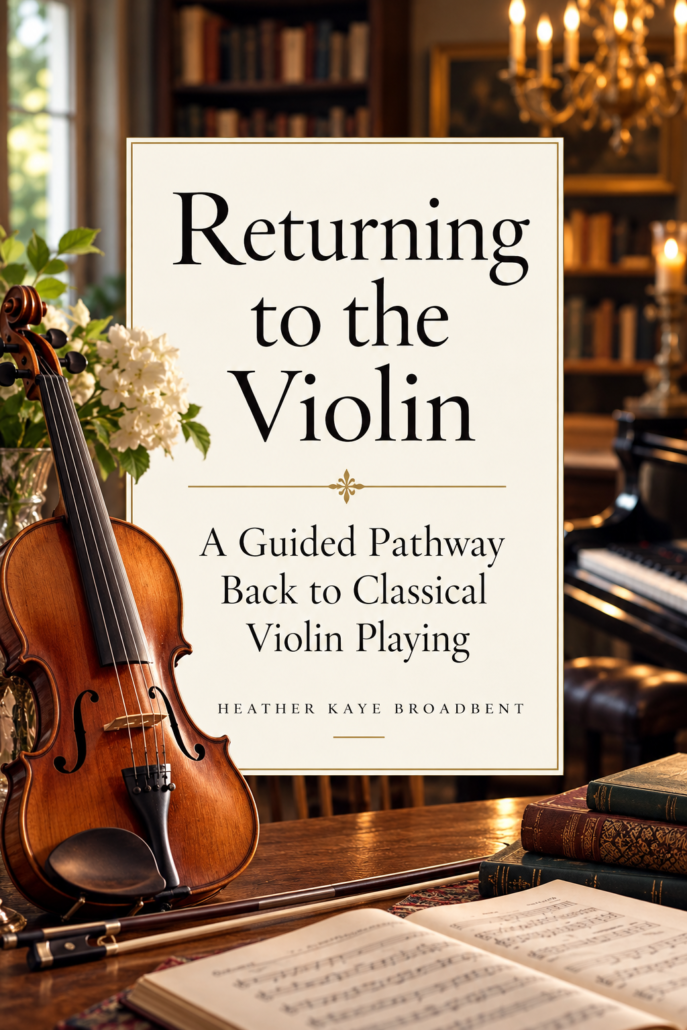
If you’d like a guided approach to rebuilding your classical violin technique, explore my course:
You can also begin with my complimentary practice resource:
Heather Kaye Broadbent is a concert violinist and founder of the Broadbent School of Violin Artistry, where she helps violinists develop beautiful tone, refined technique, and deeper musical understanding through guided study, online courses, and private instruction.
I’d Love to Hear From You
Are you returning to the violin after time away?
I’d love to hear what you’re enjoying about the experience and which aspects of your playing you’re working to rebuild. Share your thoughts or questions below!

Leave a Reply
Want to join the discussion?Feel free to contribute!