
Afraid to Practice Violin Again? How to Overcome the Resistance After Time Away
Returning to the violin after a break isn’t always a question of technique. Sometimes the greatest challenge is simply allowing yourself to begin again.
Perhaps your violin has been sitting in its case for a few weeks. Perhaps it’s been months, or even years.
You think about playing. You remember how much you enjoyed it, how beautifully a passage once sounded, or how satisfying it felt to make progress.
And yet, somehow, you don’t open the case.
You tell yourself you’ll practice tomorrow. Or next week, when you have more time. Or when you feel more motivated.
But the longer you wait, the more difficult it can become to return.
If this sounds familiar, you’re not alone. I’ve seen this resistance in violinists of many different levels, and I want to offer you a different way of thinking about your return.
In this video, I discuss the resistance that can develop after time away from the instrument, the expectations we place on ourselves, and why returning to practice doesn’t have to be such a difficult experience.

Get in Violin Shape Fast
Bring greater focus and consistency to your violin practice with my free Get in Violin Shape Fast Practice Checklist.
Whether you’re returning to the violin after time away or looking to refine your daily practice, this printable guide helps you organize your work on scales, études, bowing, vibrato, shifting, and repertoire.
Keep it on your music stand, track your progress, and make every practice session more purposeful.
Download your complimentary checklist and start practicing with intention today.
Download your free practice guide: Get in Violin Shape Fast
Why Is It So Difficult to Start Practicing Again?
When we haven’t played for a while, we often anticipate the experience before we’ve even picked up the instrument.
We imagine that our intonation will be unreliable, our bow arm will feel awkward, our fingers won’t respond, or the piece we once played comfortably will suddenly seem difficult.
And then comes the internal conversation:
I’ve lost everything I worked for.
I should be playing better than this.
It’s going to take forever to get back to where I was.
The problem is that we’re already evaluating our playing before we’ve played a single note.
Instead of looking forward to spending time with the violin, we begin to associate the instrument with disappointment, obligation, or the fear of discovering what we’ve lost.
This can turn a simple act—opening the case—into something that feels surprisingly difficult.
Your Violin Isn’t Judging You
In my video, How to Get Back into Practicing Violin After Taking Time Off, I share an analogy that I particularly love.
Think about a dog greeting its owner after they’ve been away.
The dog isn’t standing at the door wondering why you were gone so long. It isn’t disappointed that you didn’t come home sooner. It’s simply delighted to see you.
I like to imagine our violins welcoming us back in much the same way.
Your violin isn’t keeping track of how many days you’ve missed. It doesn’t care whether your scales are as polished as they were six months ago.
It’s simply there, waiting for you to play.
Of course, the violin is an instrument, not a living creature. But changing the way we imagine our relationship with it can be surprisingly powerful.
Instead of approaching the instrument as something that will expose our shortcomings, we can approach it as something familiar that we’re happy to reconnect with.
You don’t have to earn the right to enjoy playing your violin again.
The First Practice Session Is Not an Examination
One of the biggest mistakes we can make when returning to the violin is treating the first practice session as an assessment of everything we’ve forgotten.
We take out a piece we used to play well, attempt a difficult passage, and immediately compare the result with our memory of how it once sounded.
But that’s an unfair comparison.
Your first session back is not supposed to demonstrate your highest level of playing. Its purpose is to reestablish your relationship with the instrument.
You might begin with a few open strings, a familiar scale, or a melody you enjoy.
Pay attention to the feeling of the violin in your hands, the contact of the bow with the string, and the sound you’re producing.
There is no need to solve every technical problem immediately.
Allow yourself to become comfortable playing again.
When Practicing Becomes Too Much Like Working
There’s another interesting phenomenon that returning violinists sometimes experience.
They pick up the violin after a long break and are surprised by how naturally they play. They feel relaxed, unhurried, and free of expectations.
Encouraged by this, they begin working more intensely on the details.
Suddenly, the playing becomes tense. The bow feels less responsive. The intonation becomes less reliable. What initially felt easy now feels frustrating.
Why?
Sometimes it’s because our attention has shifted from making music to controlling every individual movement.
Technical study is essential to developing as a violinist. But technical concentration should help us develop greater freedom, not replace that freedom with tension.
For example, if you’re studying bow distribution or string crossings, work carefully and thoughtfully. But periodically return to playing a musical phrase without analyzing every movement.
Notice whether you can preserve the same ease of coordination.
Good practice is not simply a matter of finding more things to correct. It’s learning how to make improvements without losing the natural musical connection that brought you to the instrument in the first place.
Five Ways to Make Returning to Violin Practice Easier
1. Open the case without making a promise
You don’t need to commit to an hour of practice.
Simply take out the violin.
Sometimes the expectation of a long, demanding session is what prevents us from beginning. Remove that expectation.
You may discover that once the instrument is in your hands, you want to play.
2. Begin with something familiar
Choose a scale, a simple melody, or a piece you remember enjoying.
This isn’t the moment to test yourself with the most difficult passage in your repertoire.
Give your mind and body an opportunity to recognize familiar movements and sounds.
3. Listen before you correct
When you first begin playing, resist the urge to interrupt yourself after every imperfect note.
Listen to the sound you’re making. Notice the bow’s contact with the string and how your body responds.
You can address technical details gradually. First, allow yourself to experience playing.
4. Separate observation from judgment
There’s an important difference between noticing that your intonation needs attention and telling yourself that your playing is terrible.
One observation helps you practice intelligently. The other makes you less willing to practice at all.
A violinist who can observe without harsh self-criticism is in a much better position to make meaningful progress.
5. Finish while you still feel encouraged
Your first few sessions don’t have to be long.
A short, enjoyable practice session can be far more valuable than forcing yourself through an exhausting one.
You want to finish with the feeling that you’d like to return tomorrow.
That’s how a practice habit begins to reestablish itself.
Returning to the Violin Is Not the Same as Starting Over
Even after a substantial break, your previous musical experiences still matter.
Your ear, your understanding of phrasing, your knowledge of the instrument, and the technical coordination you’ve developed are all part of your history as a violinist.
Some skills may need refreshing. Certain movements may feel unfamiliar. Your endurance may be different.
But that doesn’t mean you’re beginning from nothing.
And you may find that time away has given you a different perspective on your playing.
Perhaps you’re more patient now. Perhaps you’re less interested in proving something and more interested in making beautiful music.
Those changes can be valuable, too.
Ready to Rebuild Your Violin Practice?
Once you’ve overcome the initial resistance to playing, the next question is often how to rebuild your technique in a thoughtful, organized way.
I’ve created a free resource to help you begin.
Get in Violin Shape Fast — Free Practice Checklist
A practical starting point for reconnecting with the essential elements of violin playing and identifying where to focus your attention.
Get Your Free Violin Practice Checklist
If you’ve been away from the violin for years and would like additional guidance, you may also enjoy my companion article:
How to Get Back Into Violin After Years Away
That article explores the more technical side of returning to the instrument, including how to organize your practice and rebuild coordination.
Your Violin Is Waiting for You
If you’ve been avoiding your violin because you’re worried about how you’ll sound, I hope you’ll give yourself permission to begin.
You don’t have to sound the way you did five years ago.
You don’t have to play a perfect scale.
You don’t have to prove that you still deserve to call yourself a violinist.
Open the case. Tune your instrument. Draw the bow across the string.
Listen.
And remember: your violin isn’t judging you.
It’s waiting to welcome you back.
Heather Kaye Broadbent
Broadbent School of Violin Artistry
Ready for a More Structured Return?
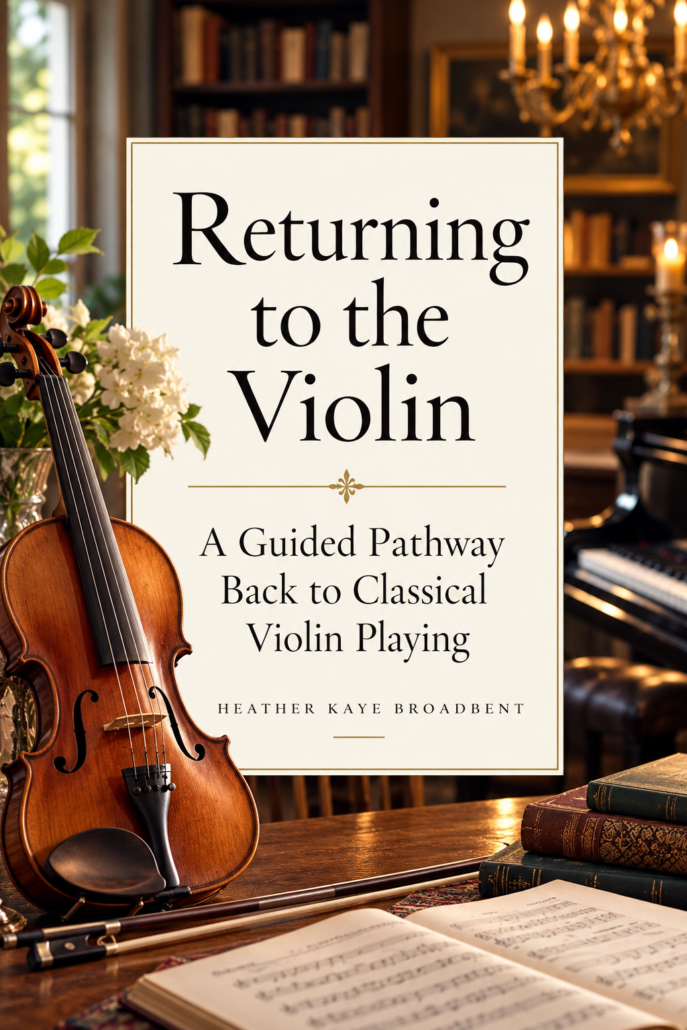
If you’d like a guided approach to rebuilding your classical violin technique, explore my course:
You can also begin with my complimentary practice resource:
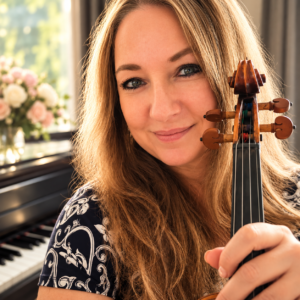
Heather Kaye Broadbent is a concert violinist and founder of the Broadbent School of Violin Artistry, where she helps violinists develop beautiful tone, refined technique, and deeper musical understanding through guided study, online courses, and private instruction.
I’d Love to Hear From You
Have you ever struggled to return to practicing after time away? What helped you finally pick up your violin again?

Leave a Reply
Want to join the discussion?Feel free to contribute!