A Living Tradition of Violin Playing
Violin pedagogy is passed from one generation to the next—not as a fixed set of rules, but through teaching, playing, listening, questioning and discovery.
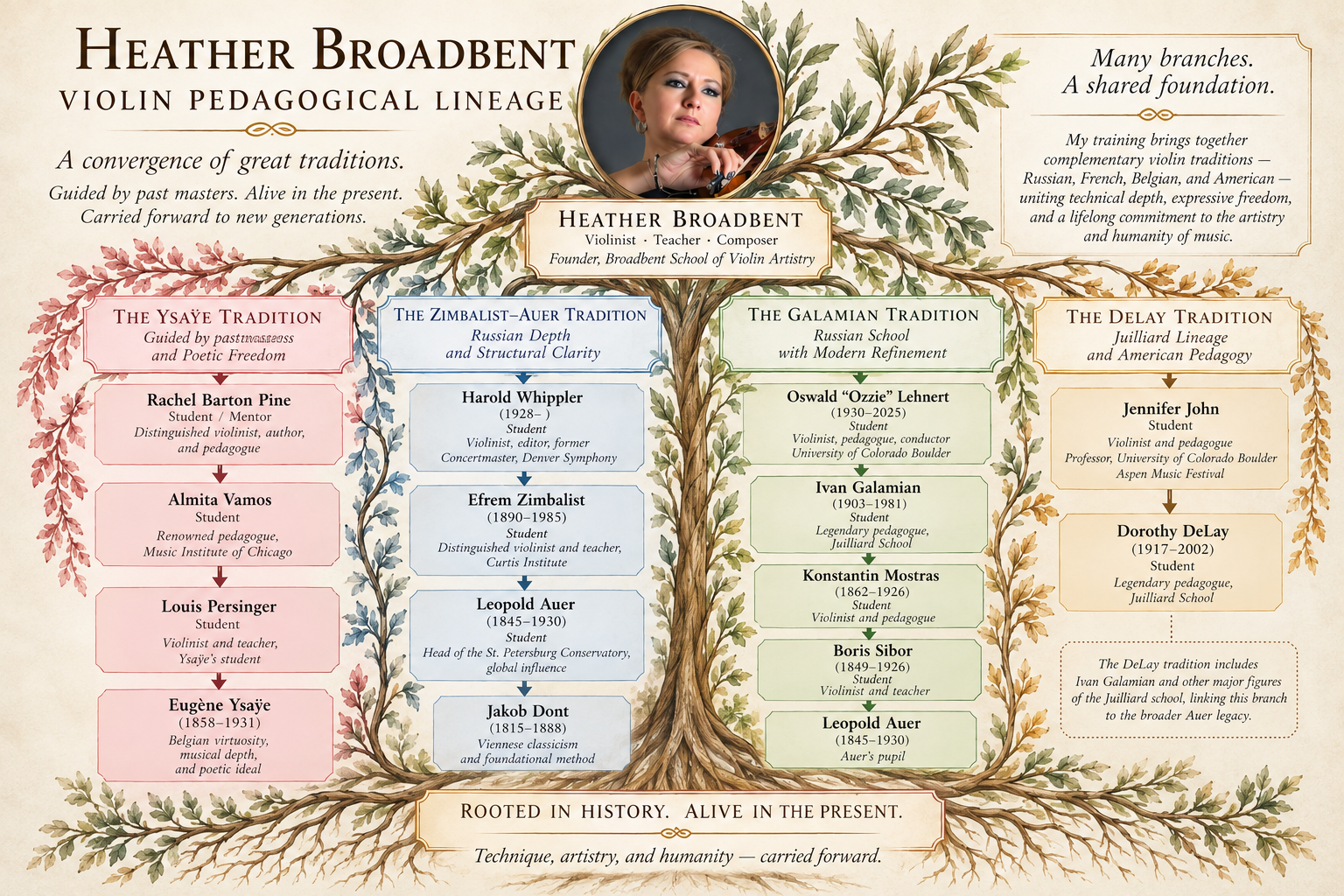
Heather Broadbent’s musical education draws from several of the great traditions of violin playing, with pedagogical lines extending through the Russian and French-Belgian schools and through some of the most influential violin teachers of the nineteenth and twentieth centuries.
These traditions do not represent a single prescribed “method.” They are branches of a living art: different approaches to technique, sound, physical organization, interpretation and the development of the individual musician.
Many Branches. A Shared Principle.
Technique in service of violin artistry.
The Pedagogical Lines
The Ysaÿe–French-Belgian Line
Heather Broadbent
↓
Rachel Barton Pine
↓
Almita Vamos
↓
Louis Persinger
↓
Eugène Ysaÿe
↓
Henri Vieuxtemps
↓
Charles-Auguste de Bériot
Heather studied with concert violinist Rachel Barton Pine.
Through Pine and Almita Vamos, this branch reaches Louis Persinger, the celebrated violin pedagogue who pursued further study with Eugène Ysaÿe in Brussels.
Through Ysaÿe and his teacher Henri Vieuxtemps, the lineage reaches Charles-Auguste de Bériot and the nineteenth-century French-Belgian tradition of violin playing.
This tradition placed extraordinary importance on sound, elegance, virtuosity and expressive freedom—not technique for its own sake, but technique capable of serving musical imagination.
Sonority · Expression · Poetic Freedom
The Galamian Line
Heather Broadbent
↓
Oswald “Ozzie” Lehnert
↓
Ivan Galamian
↓
Konstantin Mostras
↓
Boris Sibor
↓
Leopold Auer
Heather also studied with Oswald “Ozzie” Lehnert, bringing another important twentieth-century pedagogical stream into her musical education: the teaching tradition associated with Ivan Galamian.
Galamian’s approach brought together elements of Russian and French violin pedagogy and placed particular importance on the organization and coordination of violin technique.
Rather than treating technique as an accumulation of isolated mechanical skills, this tradition seeks the physical and mental coordination that allows technique to become dependable enough to serve musical intention.
Through Galamian’s Russian training, this branch ultimately reconnects with the broader pedagogical tradition surrounding Leopold Auer.
Coordination · Technical Mastery · Musical Freedom
The Auer–Russian Line
Heather Broadbent
↓
Harold Wippler
↓
Efrem Zimbalist
↓
Leopold Auer
↓
Jakob Dont
Heather studied with Harold Wippler, whose own training leads through Efrem Zimbalist to Leopold Auer.
Auer became one of the defining pedagogues of the Russian violin tradition, teaching a remarkable generation of violinists that included Zimbalist, Jascha Heifetz, Nathan Milstein, Mischa Elman and Toscha Seidel.
Yet one of the most important characteristics of Auer’s pedagogy was his resistance to producing students who all played alike. Individuality mattered. Technique provided the foundation from which the personality and musical imagination of the violinist could emerge.
Behind Auer stands the Viennese violinist and pedagogue Jakob Dont. Auer studied with Dont in Vienna and credited that period of study with establishing an important foundation for his violin technique.
Individuality · Technical Foundation · Musical Expression
The DeLay Line
Heather Broadbent
↓
Jennifer John
↓
Dorothy DeLay
↓
Ivan Galamian
Heather also studied with Jennifer John, whose teachers included Dorothy DeLay.
DeLay became one of the most influential violin pedagogues of the twentieth century. She studied with Ivan Galamian and later worked alongside him at Juilliard, before developing her own distinctive pedagogical approach. Her teaching became particularly associated with developing the individual student rather than imposing a single model of playing.
Students were encouraged not simply to follow instructions, but to listen, investigate, think independently and assume increasing responsibility for their own artistic decisions.
The connection between DeLay and Galamian also illustrates something important about violin pedagogy: these traditions are not separate branches so much as an interconnected inheritance, with ideas passing between teachers, schools and generations.
Individuality · Independent Thinking · Artistic Voice
Many Traditions. One Living Art.
These pedagogical lines did not develop in isolation. They intersected, influenced one another and evolved as ideas passed between teachers, performers and generations.
Galamian drew upon both Russian and French traditions. DeLay studied with Galamian before developing a distinctive pedagogical voice of her own. Auer, while associated with the Russian school, had himself studied in Vienna with Jakob Dont. Ysaÿe inherited the French-Belgian tradition through Vieuxtemps and carried it into a new generation of violin playing.
The result is not a single method or an unbroken set of rules.
It is an inheritance of ideas.
Across these traditions, certain principles return again and again: technical command, quality and freedom of sound, careful listening, musical imagination, and respect for the individuality of the violinist.
The Tradition Continues
Pedagogical lineage matters not because the past should be preserved unchanged, but because each generation receives knowledge, tests it at the instrument, and passes forward what remains valuable.
Heather’s own teaching is part of that continuing process.
Her work draws upon the traditions inherited through her teachers while continuing to develop through performance, teaching, historical study, research and daily work at the violin.
Tradition is something to inherit, understand, study, and continue.
Continue Your Study
The Broadbent School of Violin Artistry brings this living pedagogical tradition into a modern, international studio.
Explore the School by area of study and go directly to the work your playing needs.