
Three Beginner Violin Scales: A Major, D Major & G Major
Learning to play scales is one of the most important foundations of violin technique. Scales develop intonation, establish reliable finger patterns, strengthen note-reading skills, and help organize the left hand.
In this lesson, you’ll learn three essential beginner violin scales: A Major, D Major, and G Major.
All three use the same basic finger pattern, making them an excellent starting point for developing consistency across the instrument.
Before beginning, make sure your violin is properly tuned. Practicing scales on an instrument that is out of tune makes it difficult to establish reliable pitch relationships.
A Major Scale
The one-octave A Major scale begins on the open A string and continues onto the E string.
Notes: A – B – C♯ – D – E – F♯ – G♯ – A
Finger pattern:
A string: 0 – 1 – 2 – 3
E string: 0 – 1 – 2 – 3
In this pattern, the second and third fingers are placed close together, creating the half step between C♯ and D on the A string and between G♯ and A on the E string.
Want to see the notes on the page?
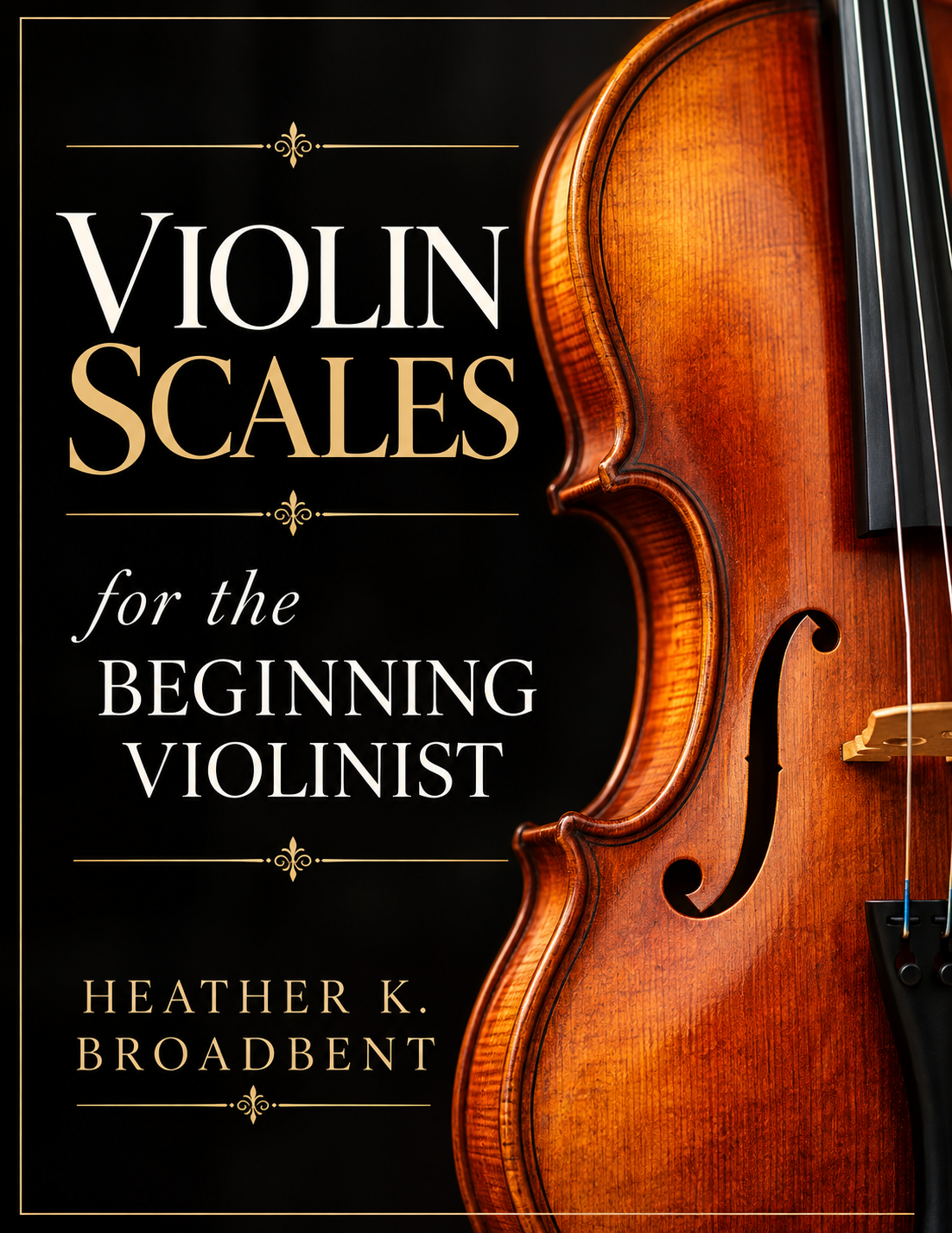
“Violin Scales for the Beginning Violinist” is a 31 page E-Book featuring one octave A Major, D Major, G Major lower and upper octaves and G Major two octave scales. Also includes “Walking,” whole step half step exercises and “Skipping,” broken third exercises followed by a broken third challenge.
All exercises walk you through the scales rhythmically fostering an effortless and extremely efficient note reading experience.
Ready to take your scale practice further?
Get your copy of Violin Scales for the Beginning Violinist, a 31-page e-book featuring progressive scale exercises, rhythmic variations, and note-reading studies.
Establishing a Balanced Left Hand
Before playing the scale, place your third finger on the A string and listen for the D.
When accurately placed, this note can produce a sympathetic resonance from the open D string.
This is also an opportunity to observe the organization of your left hand.
The hand should face the fingerboard comfortably, with a stable frame that supports all four fingers. The fourth finger should be able to function without requiring the hand to collapse or reorganize.
A balanced left hand provides the foundation for reliable intonation.
As you practice, think of the note names, not only the finger numbers. Developing this awareness early will become increasingly important as you begin shifting into different positions.
D Major Scale
The one-octave D Major scale begins on the open D string.
Notes: D – E – F♯ – G – A – B – C♯ – D
Finger pattern:
D string: 0 – 1 – 2 – 3
A string: 0 – 1 – 2 – 3
The same finger pattern used for A Major now begins one string lower.
Pay attention to the relationship between the second and third fingers while maintaining a quiet, balanced left hand.
G Major Scale
The one-octave G Major scale begins on the open G string.
Notes: G – A – B – C – D – E – F♯ – G
Finger pattern:
G string: 0 – 1 – 2 – 3
D string: 0 – 1 – 2 – 3
Again, the same finger pattern applies.
Practicing these three scales together helps you recognize consistent relationships between notes while becoming more comfortable playing across different strings.
How to Practice Beginner Violin Scales
1. Develop Accurate Intonation
Listen carefully to every note.
When a note is out of tune, return to the preceding note and practice the relationship between them. This develops a more reliable understanding of pitch than repeatedly correcting individual notes in isolation.
2. Practice with Different Bowings
Begin with long, straight whole bows, traveling from frog to tip.
Then experiment with:
- Two notes per bow
- Four notes per bow
- An entire scale in one bow
Changing the bowing helps develop coordination between the right and left hands.
3. Introduce Rhythmic Variations
Practice the same scale using different rhythmic patterns:
- Long–short
- Short–long
- Even notes
Rhythmic variations improve finger coordination and help reveal unevenness in the left hand.
4. Learn the Note Names
Say or think the note names as you practice.
Finger numbers are useful for learning patterns, but understanding the notes themselves is essential for reading music and eventually navigating different positions on the violin.
Continue Your Violin Study

Learning scales is only one part of developing a reliable violin technique.
The Art of Learning Violin offers structured instruction for violinists who want to build a solid technical foundation through a thoughtful, organized approach to learning the instrument.
Develop greater confidence in your playing while establishing the technical principles that support your continued musical development.
About Heather Kaye Broadbent
Heather Kaye Broadbent is a classically trained violinist, pedagogue, and founder of the Broadbent School of Violin Artistry.
Drawing on decades of performing and teaching experience, Heather has developed an approach to violin pedagogy centered on balance, technical organization, and a deeper understanding of how the instrument functions.
Her work helps violinists move beyond simply following instructions to understanding the principles that make technique reliable, expressive, and sustainable.
Through her online lessons, educational videos, and structured courses, Heather works with adult violinists, returning players, and teachers seeking a more thoughtful approach to violin study.



Trackbacks & Pingbacks
[…] learn the two-octave A major scale, you must learn the one octave A major scale. Head on over to my Beginner Violin Scales post if you need to have a refresher course on the one octave A major […]
Leave a Reply
Want to join the discussion?Feel free to contribute!