
How to Get Rid of Left Hand Tension While Playing the Violin
Left-hand tension is one of the most common technical difficulties violinists encounter. It can interfere with intonation, finger coordination, shifting, vibrato, and the overall freedom of movement required for expressive playing.
Many violinists attempt to solve the problem by consciously relaxing their hand, only to discover that the tension returns as soon as they begin playing.
The solution begins with understanding how the left hand is set up and how it functions in relation to the instrument.
In this lesson, we’ll examine four important elements of left-hand technique and explore practical exercises to help identify and release unnecessary tension.
1. Examine Your Violin Hold
Before addressing the left hand itself, consider how the violin is supported.
If the instrument feels insecure, the left hand may compensate by gripping the neck. This creates unnecessary tension in the thumb, fingers, and surrounding muscles.
A well-organized violin hold allows the left hand to function with greater independence.
Begin by observing whether you can maintain a comfortable relationship with the instrument without relying on excessive pressure from your left hand.
If you’re uncertain about your setup, begin with my lesson on How to Properly Hold the Violin for Best Results.
2. Discover the Natural Organization of Your Left Hand
Raise your violin into playing position, then allow your left hand to hang freely for a moment.
Gently shake out the hand and observe its natural shape.
Notice the relationship between the thumb and fingers, the natural curvature of the fingers, and the absence of unnecessary gripping.
Now bring the hand toward the violin while preserving that sense of freedom.
The objective is not to force the hand into a particular shape but to establish a balanced relationship with the fingerboard.
A balanced hand is not simply a relaxed hand. It is a hand organized to function efficiently.
This distinction is fundamental to developing a reliable violin technique.
3. Understand the Role of the Thumb
The thumb is frequently involved in left-hand tension.
When the thumb presses forcefully against the violin neck, the fingers may respond with additional pressure. This opposing action can create a gripping mechanism that restricts movement.
The thumb should function as a flexible point of reference rather than a rigid clamp.
Violinists use different thumb positions depending on their physical structure and technical approach. Some prefer a slightly higher thumb, while others use a lower placement.
What matters is the relationship between the thumb, the hand frame, and the freedom of the fingers.
Observe whether your thumb becomes rigid when you place certain fingers, change strings, or encounter difficult passages.
Learning to recognize these moments is the first step toward changing the habit.
4. Develop a Lighter Finger Action
Another common source of tension is excessive finger pressure.
The fingers must stop the strings securely, but they do not need to press with maximum force.
Excessive pressure can make finger movement slower and more difficult, particularly during rapid passages.
The goal is to discover the amount of pressure necessary to produce a clear, reliable pitch while maintaining freedom of movement.
Exercise 1: Discover How Much Finger Pressure You Need
- Place a finger on the string and deliberately apply more pressure than necessary.
- Then gradually reduce that pressure while playing the note.
- Listen carefully to the sound.
- At some point, the finger will become too light to stop the string cleanly. Increase the pressure just enough to restore a clear pitch.
- Repeat this process with different fingers.
This exercise develops awareness of the difference between necessary finger contact and unnecessary muscular effort.
5. Exercises for Releasing Thumb Tension
Exercise 2: Playing Without the Thumb
Choose a familiar, simple scale.
With the violin securely supported, experiment briefly with playing individual notes while releasing the thumb from contact with the neck.
You may notice changes in intonation or hand stability. The purpose is not to establish a permanent thumb-free playing technique but to discover how much unnecessary pressure you may be using.
The fingers can act independently without requiring a constant squeezing motion between the thumb and fingerboard.
Return the thumb to its normal position and notice whether you can preserve that sense of freedom.
Exercise 3: The Thumb Dance
This is one of my favorite ways to check for unnecessary tension during practice.
Play a familiar scale with your thumb in its usual position.
Occasionally, make a small, gentle movement with the thumb—a little thumb dance—to determine whether it is free to move.
If the thumb feels locked against the neck, pause and reorganize the hand before continuing.
You can apply this exercise to passages in your repertoire whenever you notice tension beginning to develop.
6. Identify When the Tension Appears
Left-hand tension is not always constant.
It may occur only when placing the fourth finger, reaching for a low second finger, changing strings, or preparing for a shift.
Rather than thinking only about relaxing, begin investigating the exact movement that produces the tension.
Ask yourself:
- Which finger or movement causes the hand to tighten?
- Does the thumb respond by pressing against the neck?
- Does the hand frame change unnecessarily?
- Can the movement be organized with less effort?
This kind of observation transforms tension from a recurring frustration into a technical problem that can be understood and addressed.
Continue Your Study: The Balanced Left Hand
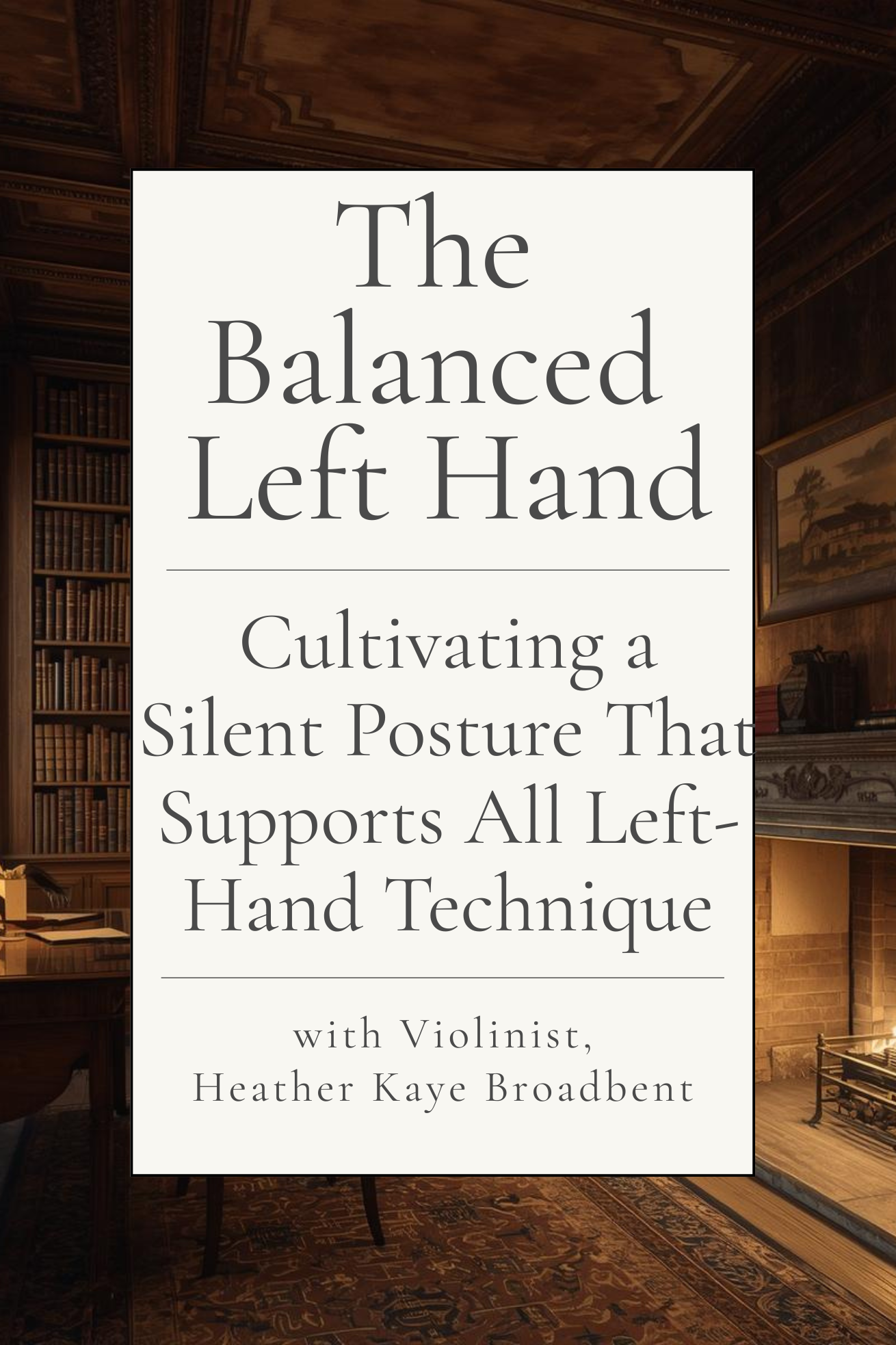
Develop a deeper understanding of left-hand balance, organization, and technical freedom.
Releasing tension is only the beginning. Lasting technical freedom depends on understanding the relationships between the thumb, fingers, hand frame, and instrument.
In The Balanced Left Hand, I explore these principles through a structured approach to violin technique.
The course addresses:
- Establishing a balanced and responsive left-hand frame
- Understanding thumb placement and its function
- Developing finger independence and reliable placement
- Organizing the fourth finger
- Creating the technical foundations for shifting, vibrato, and accurate intonation
Designed for serious adult violinists, returning players, and teachers, this focused course provides an opportunity to study the mechanics of the left hand in greater depth.
About Heather Kaye Broadbent
Heather Kaye Broadbent is a violinist, pedagogue, and founder of the Broadbent School of Violin Artistry.
Drawing on decades of international performing and teaching experience, Heather’s pedagogical approach emphasizes technical understanding, physical balance, and the relationship between technique and musical expression.
Through her educational courses, online instruction, and YouTube lessons, she helps violinists develop a more informed and independent approach to their playing.
Explore the Broadbent School of Violin Artistry →
What have you discovered about tension in your own left hand? Share your experience in the comments below. I’d love to hear which exercise was most helpful.


Trackbacks & Pingbacks
[…] Using a shoulder rest also eliminates tension in your left hand while you play. Be sure to check out my post, How to play without tension in your left hand. […]
Leave a Reply
Want to join the discussion?Feel free to contribute!