
Why Violin Progress Stalls — And What Actually Changes It
If the violin has called you, you are in the right place.
Something inside you wants to sing freely through the instrument. Yet many violinists feel blocked. Fear, lack of confidence, or frustration can stop that musical voice from emerging.
Sometimes the problem feels technical.
Sometimes it feels emotional.
Often, it is both.
You may feel stuck because you believe you must perfect one skill before moving forward. Or perhaps you sense there are gaps in your training that were never properly addressed.
You might think:
“If I only had the right instruction for vibrato, intonation, bow distribution, shifting, or tone… then everything would finally make sense.”
In many cases, that instinct is correct.
Watch the video where I explain why violin progress stalls and how to change your practice strategy.
Violinists who want to go deeper into tone development can explore the Gorgeous Tone Training course inside the Broadbent School of Violin Artistry.
What Progress Actually Requires
Real progress happens when the end result is presented in a way that is understandable today, not years from now.
When a violinist has a clear practice strategy, every minute in the practice room becomes meaningful.
Instead of guessing what to do next, each step moves directly toward the desired outcome.
My role as a teacher is to take seemingly impossible goals and break them into small, practical steps that can be integrated into daily practice.
When those steps are implemented mindfully, progress appears far faster than most violinists expect.
Often it is not about practicing more hours.
It is about practicing with greater clarity.
A Student’s Experience
One student recently wrote to me:
“What makes you so fantastic are your clear and gentle explanations. Your camera angles help tremendously and everything is easy to understand. I’m trying to return to the violin at age 68 after starting at six. My playing is so much more relaxed now instead of muscling everything.”
Violin is already difficult.
We do not need to make it harder by practicing in ways that create tension and confusion.
The Evolution of Online Violin Teaching
When I began teaching violin online in 2012, many colleagues believed it was impossible to teach classical violin effectively this way.
Years later, after the shift to online learning during COVID, those same colleagues began asking how online teaching actually works.
Even institutions such as the Royal Conservatory of Music have interviewed me about effective online violin instruction.
There has never been a better time to study violin online.
Students can now access excellent instruction without commuting, scheduling conflicts, or geographical limitations.
However, teaching online successfully requires adapting the method itself.
Traditional teaching approaches do not automatically translate to the online environment.
The Three Biggest Mistakes Violinists Make
1. Playing Piece After Piece
Many violinists believe progress means constantly learning new repertoire.
But without addressing the technical foundation underneath, each new piece simply reinforces the same problems.
2. Playing Etudes That Are Too Difficult
Etudes are valuable only when they match the technical level of the player.
When the notes themselves are too difficult, the underlying technique cannot develop properly.
3. Reinforcing Limiting Beliefs
Many violinists quietly believe:
• I started too late
• I’m too old
• I don’t have enough time
• I’m not talented enough
These beliefs create mental barriers that block progress before it even begins.
The Deeper Cause of Stagnation
When the real issue is never addressed, violinists eventually develop a painful belief:
“I’m just not getting better.”
In reality, the fundamental problem has simply never been isolated and solved.
Years of repetition can reinforce inefficient habits.
And unfortunately, unlearning habits later is often harder than learning correctly from the beginning.
A Better Practice Strategy
When practice shifts from quantity to quality, results can change dramatically.
Sometimes meaningful progress can begin with just three minutes a day focused on the right element.
Without changing the strategy, however, the outcome will never change.
The Four Dimensions of Violin Development
Healthy violin playing functions like a kaleidoscope with several interconnected elements.
These can be understood through four dimensions.
Physical
The body must support the instrument efficiently.
Left Side:
• violin hold
• thumb placement
• finger support
• left elbow alignment
• intonation
• vibrato
• shifting
Right Side:
• bow arm mechanics
• shoulder and elbow coordination
• finger roles in the bow hold
• bow speed
• bow distribution
Without physical balance, tone production becomes limited.
Emotional
Music communicates feeling.
If a violinist feels emotionally connected to the music but cannot release that expression physically, frustration builds.
When physical and mental barriers are reduced, emotional expression becomes natural.
Mental
Violin practice requires awareness without judgment.
Mistakes are part of the process.
Stopping after every error or criticizing oneself constantly interrupts musical flow.
The ability to remain present during practice is essential for progress.
Vibrational
Everything about the violin is vibration.
The instrument vibrates.
The strings vibrate.
And the player vibrates.
Limiting beliefs often interrupt this flow of energy.
For example, many violinists have experienced this moment:
“Here it comes… I always miss this shift…”
And then it happens.
The note is missed again.
Learning to release these belief patterns is part of developing artistic freedom.
Why a System Matters
Because violin playing involves many interconnected elements, it is extremely difficult to diagnose problems alone.
What violinists need is a structured approach.
A system that focuses on tone production through the relationship between the body, mind, and instrument.
This means:
1️⃣ Identifying the foundational issue blocking tone production.
2️⃣ Understanding the roles of the left and right sides of the body.
3️⃣ Practicing specific exercises that develop tone.
4️⃣ Avoiding blind repetition that reinforces problems.
5️⃣ Applying consistent, focused practice.
With the correct training, violinists often see dramatic improvement within 30 minutes of focused practice per day.
Moving Beyond Plateaus
Many violinists have played for years yet struggle with the same problems.
This usually happens because no one has worked with them in a focused way to identify what is truly holding them back.
My teaching combines performance experience, technical training, and intuitive observation.
Often the smallest adjustment in practice strategy can create enormous progress.
Perfectionism can also keep violinists stuck.
Growth requires allowing yourself to move forward even when things are not perfect yet.
Final Thoughts
If you feel called to the violin but sense something is missing in your progress, you are not alone.
With the right system, the right exercises, and the right mindset, the instrument can begin to open in ways that previously felt impossible.
The goal is not perfection.
The goal is freedom.
Study Violin with Personal Guidance
If your violin progress feels stalled, a private lesson can help identify exactly what is holding you back.
In private online lessons we focus on the elements that shape beautiful violin playing — tone production, bow coordination, intonation, and efficient practice strategy.
Each lesson is tailored specifically to your playing so that the next steps in your development become clear and achievable.
🎻 Schedule your private online lesson below
Happy Practicing,

What has been the biggest obstacle in your violin progress so far? Let me know in the comments below.
Heather Kaye Broadbent is a classically trained concert violinist and the founder of the Broadbent School of Violin Artistry, an online learning environment dedicated to helping violinists develop beautiful tone, refined technique, and deeper musical understanding.
She received her Bachelor of Music in Violin Performance from the University of Colorado Boulder and has performed professionally in both the United States and Europe, including orchestral work in Bulgaria with the Gabrovo Chamber Orchestra and the Yambol Chamber Orchestra. Earlier in her career she held leadership positions in orchestras throughout the greater Chicago–Milwaukee region.
Through her teaching, Heather has worked with millions of violinists worldwide via YouTube lessons, online courses, group coaching programs, and private instruction. Her students have earned awards in competitions, held concertmaster positions in youth and regional orchestras, and performed in prestigious venues including Carnegie Hall.
Her teaching philosophy emphasizes gorgeous tone, balanced technique, and thoughtful musicianship, guiding violinists to develop not only technical skill but a lifelong relationship with music.
Heather is also an advocate for a holistic approach to violin playing, recognizing that physical awareness, mental focus, and artistic curiosity all play an important role in the violinist’s journey.
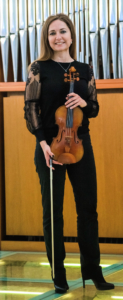
 © Heather Kaye Broadbent
 Heather Kaye Broadbent
Leave a Reply
Want to join the discussion?Feel free to contribute!