
Vivaldi Violin Concerto in A Minor – Allegro | Violin Performance
Antonio Vivaldi’s Violin Concerto in A Minor, Op. 3 No. 6 is one of the most recognizable concertos in the violin repertoire. The first movement, Allegro, introduces violinists to the structure and energy of Baroque concerto writing while demanding coordination between bow articulation, rhythm, and musical direction.
For many violinists, this concerto represents an important transition: moving beyond isolated technical exercises and into sustained musical form. The Allegro movement in particular requires clarity of articulation, rhythmic stability, and awareness of how musical phrases respond to one another.
In the video below, we explore the Allegro movement of Vivaldi’s Violin Concerto in A Minor and look at how violinists can approach the movement with both technical clarity and musical intention.
Watch the Allegro Movement
Understanding the Allegro Movement
The first movement of Vivaldi’s A Minor Concerto is built around the energetic dialogue typical of Baroque concertos.
Rather than a single continuous melody, the music unfolds through recurring ideas and responses. Learning to recognize these patterns helps violinists organize their practice and shape phrases more musically.
As you study this movement, pay attention to three important elements:
Clear Bow Articulation
The Allegro movement relies on articulate bow strokes that allow each note to speak clearly. When the bow arm remains balanced and relaxed, the passagework becomes much easier to control.
Rhythmic Stability
The motor of the movement is rhythm. Keeping the pulse steady allows the musical phrases to flow naturally and prevents technical passages from becoming rushed or uneven.
Musical Conversation
Like much of Vivaldi’s concerto writing, the violin line often feels like a conversation. Recognizing repeating figures and sequences helps violinists shape phrases rather than playing the movement as a stream of unrelated notes.
Why This Concerto Matters for Violinists
Among the hundreds of concertos written by Vivaldi, the A Minor Concerto from L’estro armonico remains one of the most widely studied.
Many violinists first encounter it while developing comfort with:
• concerto form
• expressive phrasing
• early work in third position
• coordination between bow articulation and musical structure
Studied carefully, the piece becomes more than a repertoire milestone. It becomes a foundation for understanding how technique supports musical direction.
Study the Complete Concerto
If you are working on Vivaldi’s Violin Concerto in A Minor, you may enjoy studying the piece more deeply inside the full guided repertoire course.
This course explores all three movements of the concerto:
• Allegro
• Largo
• Presto
Rather than rushing through the piece, the study unfolds step by step — identifying the most important technical passages and clarifying the musical structure so that practice becomes purposeful and organized.
💫 Continue the study here:
https://shop.heatherkayeviolin.com/b/TXaL5
Inside the course you will find a complete movement-by-movement study designed to help violinists build confidence, reliability, and musical understanding within the concerto.
Practicing the Allegro Movement Mindfully
One of the most effective ways to approach this movement is to identify the technically demanding passages early rather than avoiding them.
When difficult sections are addressed first, violinists develop confidence quickly and gain a clearer sense of the concerto’s technical language.
Instead of treating the movement as a series of unrelated exercises, listen for how phrases relate to one another. This perspective helps transform practice from note-learning into musical understanding.
Final Thoughts
The Vivaldi A Minor Concerto remains popular not because it is easy, but because it introduces violinists to the deeper coordination required in concerto playing.
With thoughtful study, the Allegro movement becomes an opportunity to develop both technical reliability and expressive clarity — skills that carry forward into every future concerto.
Happy Practicing,

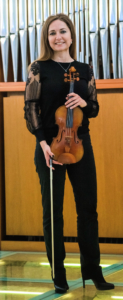
Heather Kaye Broadbent is a classically trained concert violinist and the founder of the Broadbent School of Violin Artistry, an online learning environment dedicated to helping violinists develop beautiful tone, refined technique, and deeper musical understanding.
She received her Bachelor of Music in Violin Performance from the University of Colorado Boulder and has performed professionally in both the United States and Europe, including orchestral work in Bulgaria with the Gabrovo Chamber Orchestra and the Yambol Chamber Orchestra. Earlier in her career she held leadership positions in orchestras throughout the greater Chicago–Milwaukee region.
Through her teaching, Heather has worked with millions of violinists worldwide via YouTube lessons, online courses, group coaching programs, and private instruction. Her students have earned awards in competitions, held concertmaster positions in youth and regional orchestras, and performed in prestigious venues including Carnegie Hall.
Her teaching philosophy emphasizes gorgeous tone, balanced technique, and thoughtful musicianship, guiding violinists to develop not only technical skill but a lifelong relationship with music.
Heather is also an advocate for a holistic approach to violin playing, recognizing that physical awareness, mental focus, and artistic curiosity all play an important role in the violinist’s journey.
Which of these string-crossing tips will you try in your next practice session? Let me know in the comments below.
 © Heather Kaye Broadbent
 © Heather Kaye Broadbent
Leave a Reply
Want to join the discussion?Feel free to contribute!