
Clean String Crossings on the Violin
How to Stop Hitting Other Strings While Playing
If you find yourself accidentally hitting other strings while playing the violin, the most important thing you can do is stop and investigate the problem immediately.
String crossing issues do not fix themselves automatically. Practicing for hours without addressing the cause will only reinforce the habit.
The first step is always awareness.
Instead of continuing through the passage and hoping it improves, pause and examine what is actually happening with the bow.
Watch the Lesson
In this lesson, you’ll learn how to develop clean violin string crossings so that your bow moves confidently from one string to another without unwanted noise.
Why String Crossings Become Messy
Many violinists notice that while playing pieces, scales, or etudes they begin to hit neighboring strings unexpectedly.
This usually happens because the bow arm:
• moves horizontally before arriving on the new string
• uses a larger motion than necessary
• doesn’t anticipate the next string
• loses awareness of bow direction
The solution is to isolate the crossing and practice it deliberately.
Step 1: Mark the Passage
When you notice unwanted string noise, stop and mark the location in your music.
You might use:
• parentheses
• brackets
• a quick pencil circle
Then investigate the passage and determine:
• which string you are leaving
• which string you are moving to
• which bow direction occurs before the crossing
Writing this information directly in the music helps clarify the motion.
Step 2: Practice the Crossing on Open Strings
Before adding the left hand, practice the motion using open strings only.
This allows you to focus entirely on the bow mechanics.
Move slowly between the two strings and listen carefully.
Your goal is to hear a clean change of string with no accidental contact.
Once the motion is stable, you can add the left hand back into the passage.
Step 3: Identify the Difficult Direction
Often the crossing works well in one direction but not the other.
For example:
• Lower string → higher string may feel easy
• Higher string → lower string may feel unstable
By isolating the difficult direction, you can practice it repeatedly until the movement becomes reliable.
Step 4: Write the Bow Direction in the Music
Many violinists assume they know the bow direction in a passage.
However, writing the bow direction directly into the score can make the movement much clearer.
For example:
Up bow on the A string
Down bow on the D string
This eliminates hesitation and helps the bow arm prepare the motion ahead of time.
Step 5: Minimize the Motion
Once the crossing is clean, the next step is refining the motion.
The strings are close together, so the bow arm does not need a large movement.
Instead, focus on small, efficient adjustments.
You can think about aiming toward:
• the left side of the A string
• the right side of the D string
This helps the bow arrive on the new string smoothly.
Anticipate the New String
A helpful idea is to anticipate the next string before you arrive there.
While playing the final note on the old string, the bow arm is already preparing the motion toward the new string.
This anticipation helps create smoother and more blended string crossings.
Develop Gorgeous Tone
Clean string crossings are essential for producing a beautiful violin sound.
Inside Gorgeous Tone, violinists learn the principles that allow the bow to produce a resonant and controlled sound while maintaining relaxed technique.
Final Thoughts
String crossings are a small movement, but they have a huge impact on the clarity and quality of your sound.
By slowing down, isolating the motion, and practicing deliberately, you can eliminate accidental string noise and develop clean, confident violin string crossings.
Happy Practicing,

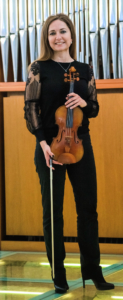
Heather Kaye Broadbent is a classically trained concert violinist and the founder of the Broadbent School of Violin Artistry, an online learning environment dedicated to helping violinists develop beautiful tone, refined technique, and deeper musical understanding.
She received her Bachelor of Music in Violin Performance from the University of Colorado Boulder and has performed professionally in both the United States and Europe, including orchestral work in Bulgaria with the Gabrovo Chamber Orchestra and the Yambol Chamber Orchestra. Earlier in her career she held leadership positions in orchestras throughout the greater Chicago–Milwaukee region.
Through her teaching, Heather has worked with millions of violinists worldwide via YouTube lessons, online courses, group coaching programs, and private instruction. Her students have earned awards in competitions, held concertmaster positions in youth and regional orchestras, and performed in prestigious venues including Carnegie Hall.
Her teaching philosophy emphasizes gorgeous tone, balanced technique, and thoughtful musicianship, guiding violinists to develop not only technical skill but a lifelong relationship with music.
Heather is also an advocate for a holistic approach to violin playing, recognizing that physical awareness, mental focus, and artistic curiosity all play an important role in the violinist’s journey.
Which of these string-crossing tips will you try in your next practice session? Let me know in the comments below.
 © Heather Kaye Broadbent
Leave a Reply
Want to join the discussion?Feel free to contribute!