
Bach Violin Concerto in A Minor – Third Movement Allegro Assai (Violin Performance)
f you’re learning how to play the Violin Concerto in A Minor, hearing a clear performance of the third movement can help you understand how structure, bowing, and phrasing come together at tempo.
J.S. Bach’s Violin Concerto in A Minor, BWV 1041 is one of the most important works in the violin repertoire. In the Allegro assai, clarity of bow distribution, rhythmic stability, and structural awareness are essential.
Because the music follows Baroque articulation, violinists must balance rhythmic stability with clear musical shaping. When the bow arm remains organized and the left hand moves efficiently, the structure of the movement becomes easier to hear and coordinate.
Violin Performance
This performance of Bach Violin Concerto in A Minor helps you hear how bowing, phrasing, and structure come together in the third movement at tempo.
How to Approach the Third Movement
If you are learning the third movement of Bach Violin Concerto in A Minor, begin by organizing the structure rather than focusing only on individual notes.
Start by:
• Identifying sequential patterns
• Planning bow distribution across phrases
• Practicing slowly with rhythmic stability
• Listening for clarity across string crossings
When these elements are clear, the movement becomes much easier to control and shape musically.
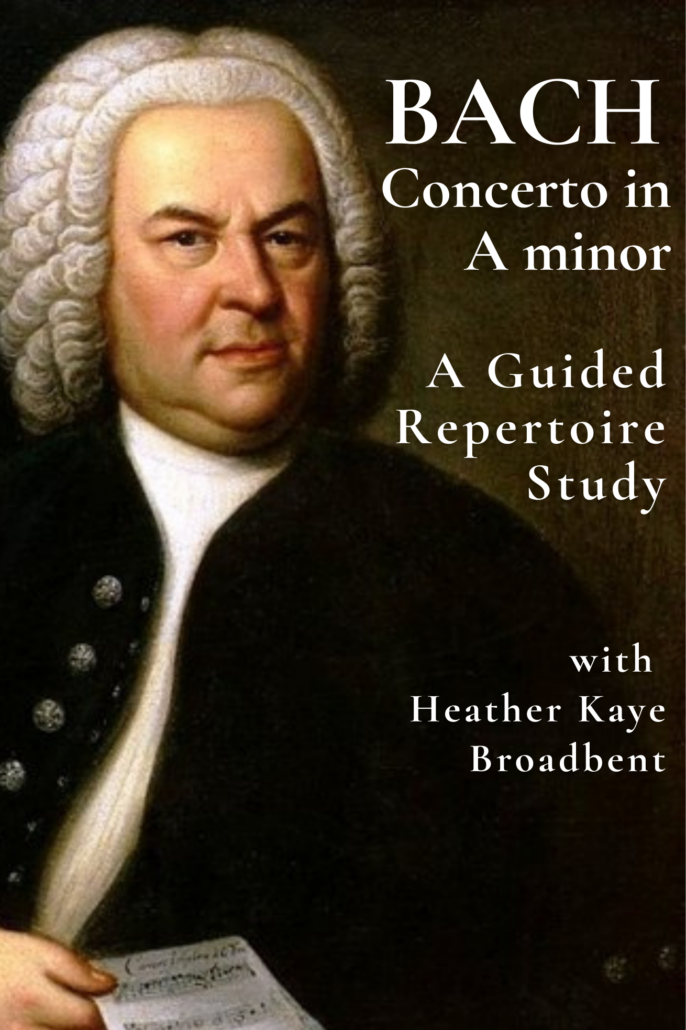
Study the Entire Concerto Step-by-Step
This lesson is part of a complete guided study of the Bach Violin Concerto in A Minor inside the Broadbent School of Violin Artistry.
Rather than approaching the concerto as isolated passages, the course presents the work as a coherent musical and technical journey, supporting violinists in developing tone, coordination, phrasing, and structural understanding.
Inside the program, you’ll find:
• Detailed practice guidance for each movement
• Step-by-step technical breakdowns
• Bowing and intonation strategies
• Musical phrasing and structure
• Guided repertoire coaching
💫 Explore the full course inside the Broadbent School:
Understanding the Third Movement of Bach Violin Concerto in A Minor
Much of the Allegro assai unfolds through repeating patterns and sequential development.
Rather than treating the music as a continuous stream of notes, violinists benefit from recognizing the structural patterns Bach uses to build momentum. Each sequence develops the material slightly differently, requiring careful control of bow distribution and articulation.
When these relationships become clear, the movement becomes easier to organize both technically and musically.
Studying the Bach Violin Concerto in A Minor
For many violinists, this concerto serves as an introduction to deeper Baroque concerto playing.
Important skills developed through this piece include:
• Balanced bow distribution across longer phrases
• Clarity in repeated sequential patterns
• Left-hand coordination within rapid passagework
• Awareness of harmonic structure within musical lines
These elements form an important foundation for later Bach repertoire and for violin concertos that demand similar structural clarity.
Accompaniment
The accompaniment used in this performance is provided by Tomplay, an interactive platform that allows violinists to practice repertoire with high-quality orchestral and piano accompaniments.
What to Study Before and After Bach A Minor
After studying the Violin Concerto in A Minor, many violinists feel ready to continue into new repertoire while building on the coordination, clarity, and musical understanding developed through this work.
Before Bach A Minor
If you have not studied the following works before learning Bach A Minor, I recommend working on them to strengthen the technical and musical foundation:
Oskar Rieding
Concertino in A Minor, Op. 21
Friedrich Seitz
Student Concerto No. 2 in A Minor, Op. 13
Antonio Vivaldi
Violin Concerto in A Minor, Op. 3 No. 6
In my own teaching, I have also found the following to be very effective at this stage:
Joseph Haydn
Violin Concerto in G Major
After Bach A Minor
After completing Bach A Minor, violinists are well positioned to continue into:
Johann Sebastian Bach
Violin Concerto in E Major, BWV 1042
This concerto builds on the same foundations while expanding technical demands, phrasing, and musical contrast.
If you are ready to explore a different composer, I often suggest:
Jean-Baptiste Accolay
Violin Concerto No. 1 in A Minor
Related Studies
If you are learning how to play Bach Violin Concerto in A Minor, continue your study here:
- Bach Violin Concerto in A Minor – First Movement Allegro
- Bach Violin Concerto in A Minor – Second Movement Andante
- How to Practice Bach Violin Concerto in A Minor – Third Movement (m. 82-90)
- How to Practice Bach Violin Concerto in A Minor – Third Movement (m. 105-116)
💫 Explore the full guided course:
Bach Violin Concerto in A Minor Guided Repertoire Study
Happy Practicing,

Study Violin with Personal Guidance
If something in your violin playing still isn’t working the way you’d like, individualized guidance can often reveal the missing piece.
In private online lessons we focus on the specific elements that shape beautiful violin playing — tone production, bow coordination, intonation, and thoughtful practice strategy.
Each lesson is tailored to your playing so that the next steps in your development become clear and achievable.
For violinists seeking deeper progress and consistent guidance, lesson packages offer the most effective and economical way to study.
Heather Kaye Broadbent is a concert violinist and founder of the Broadbent School of Violin Artistry, where she helps violinists develop beautiful tone, refined technique, and deeper musical understanding through guided study, online courses, and private instruction.

I’d Love to Hear From You
Have you studied this piece or worked through similar technical challenges?
Feel free to share your experience or questions below.

Leave a Reply
Want to join the discussion?Feel free to contribute!